Tuesday, June 12, 2012

Male Photographer in Public Is NOT Equal to "Pervert"

One trend I've noticed in recent years which I do NOT agree with, and am in fact strongly against--the presumption that a male photographer taking photos out in public must be a pervert or a participant in the child pornography industry. In other times, I've noticed--yes, even experienced it myself--where taking a photo of your own kid, and someone else's kids happened to be in the frame or close to it, elicits harsh reactions from other people. Thanks to the media, between Adam Walsh, Nancy Grace, "To Catch a Predator" on Dateline NBC, and just presumptions in general, being a male daring to use your camera in public in a totally legal & ethical way nonetheless can easily elicit glares of suspicion or even worse, occasionally legal accusations or threats, even threats of bodily harm.

It is sickening, it's prejudiced, it's wrong, and I could not be more in disagreement of it.

I have experienced it myself, & I've read & heard-of plenty of accounts of others experiencing in. In this story here, a guy describes (in "letter #2") an experience whereby he was using his DSLR to photograph his kids at a public lake, and he was approached by someone who was fearful of him thinking he was trying to sneak photos of their children for explotative purposes. I liked his response: he was not apologetic at all about it, and expressly stated he had the right to photograph what he wanted to in public1 (although it happened to be he was only photographing his own kids to start with) and he did not at all back down from it.

I have had a couple of experiences. I was once photographing the ducks at a lake, and had someone yell out "don't take photos of my kids, you pervert!" My reply: "don't worry, I only photograph things which look good." (In other words, your kid is ugly.) In another case, we were at a garage sale, and a girl of about age 12 or so took a liking to our 1 year old son, and picked him up and held him. I took a photo of it, as I was enjoying the sweetness of this young girl enjoying our 1 year old son. Shortly after, this child's mother appeared and asked me to delete the photograph on the grounds of "I don't know you."

I initially explained that I was a hobbyist photographer & that in fact people have hired me or asked me as a courtesy to take photographs for them, and that I otherwise take photos for my own personal interest anyway, & I was only photographing my son and her child enjoying each other so as to remember the sweetness of this occasion. She was still not satisfied, so I then rebutted this way: "well, I don't know you, and I don't know your girl, who in fact picked up our son without asking, not that it bothers me, but hey, if you want to make a thing of it, then why, for all I know, your daughter might be into ecstasy or meth lab drugs and might be trying to feed them to my son. But I don't think like that, all I see is a sweet moment between 2 very young people. It's enjoyable, in an innocent way, & you'd do well to think of it that way instead of making about something perverted when it's nothing of the sort."

I didn't delete the photo.

A 43 year old man who's been into photography to one extent or the other going back to 1983, I dealt with the frustrations of film and was not able to practice my hobby much as I would've liked. It took 20 more years for me to have a digital camera of good quality which would allow me to really participate in this hobby without the restraints of dealing with film. Now, I'm unleashed. I'm not about to hold back based on fear mongering and paranoid hysteria that makes a totally ridiculous assumption about me based on something I had nothing to do with--my gender.

I am not disrespectful--some social situations may call for a little discretion or restraint (one person didn't want me taking photos inside the church at her son's funeral, and I complied without any grumbling), but doing so based on paranoia and the presumption that I might be a pedophile because I'm a male practicing photography, much as Henri Cartier-Bresson did many years ago (not that I'm anywhere near as good as he is, you understand), is completely ridiculous and baseless.

Yes, I am a parent, and I still say this--and no, I have no problem if anyone were to photograph my kids in public, either.

Those who do have a problem? They need to lighten up, not expect me or anyone else to put my camera away in public because of irrational fears and paranoia.

__________________________
1 Photographer's Bill of Rights (PDF File)

Sunday, June 10, 2012

How To Blur Your Background in Portraits

One common & helpful technique to apply to portrait shots is to "downplay" the background so as to make your subject stand out. This is especially desirable if the background is not aesthetically pleasing and is distracting, but it can also be used even if the background is fine but you still wish to bring to bring emphasis to your subject. The "bokeh" which results can be very pleasing and really add a pleasing aesthetic to your portraits.

A portrait without a blurry background. Shot at f/8,
18-55mm lens at 45mm, with considerable distance from the subject
This is very easily done if you're using a larger-sensored camera such as a DSLR, especially a "full-frame" one, but can still be easily done with a "cropped" sensor camera, such as my Nikon D5100. (It's more difficult to do with cameras with sensors smaller than this.)

The trick is understanding depth-of-field. Depth-of-field refers to how much of your photograph, front-to-back, is in focus. If you have shallow depth-of-field, your subject will be sharp, but your background blurry--in extreme cases, the depth-of-field may be so shallow that your subject's eyes (in the case of portraits) will be sharp but their nose may not be. On the other hand, if you have deep depth-of-field, then most everything front-to-back will be in sharp (or acceptable) focus.

Depth-of-field is affected by many factors. The 3 main ones I will elaborate on in this article: distance between photographer & object focused on, focal length of lens, and f-stop setting.

With the first: the closer you are to your subject (assuming that's what you focus on), the more shallow the depth-of-field is. On the other hand, if you put some distance between you & the subject your lens is focused on, there is more depth-of-field.

With the second: lenses with shorter focal lengths (say, 18-24mm) have more depth-of-field than lenses, say, with a longer focal length of 135mm or more, say. Lastly, and the one most easily & perhaps most commonly varied, especially at the time of the shoot: assuming all else is equal, a large f-stop of, say, f/2.5 will provide very little depth-of-field, whereas a smaller f-stop of, say, f/11, will provide much more. (On the other hand, even at f/11, if your subject is close & you are using a longer-focal length lens, depth-of-field will still be shallow.)

A portrait with a blurry background. Shot at f/2.5, closer
to subject, with a 50mm f/1.8 lens
To achieve a portrait with a blurry background, with what I call the "bokeh effect," photographers will typically get rather close to their subject, often-times enough to only show the head & shoulders, use a lens with a focal length of 50mm or longer (50mm is especially common because "primes" with larger maximum f-stops are readily available, compact, and less expensive), and a "wide" (or large) f-stop of, say, f/2.8 or so. 

Typical "kit" lenses found on DSLRs, commonly 18-55mm, don't work well because their maximum f-stop is only f/5.6 at the 55mm setting, not usually wide (or large) enough to achieve the desired effect. On the other hand, the "supplemental" 55-200mm lenses that may also be included can achieve this, if you zoom in around 135mm or so and shoot at the maximum f/5.6 that's common for such lenses.

However, typically, a photographer will use "prime" (non-zoom) lenses such as the 50mm f/1.8 (or f/1.4), 85mm f/1.8 (or, again, f/1.4), or they will use "constant aperture" zoom lenses such as a 70-200m f/2.8 or 50-135mm f/2.8. Of these, by far the most inexpensive (and typically also compact in size) tends to be the 50mm 1.8, which is why many photographers use that lens.

The effect can be varied, too. The 2 photos shown illustrate somewhat extreme variances of depth-of-field, but an effect somewhere in-between these 2 extremes can also be achieved. This may work if the background is not necessarily distracting or tacky-looking, but you nonetheless wish to "downplay" it just a bit, versus throwing it completely out-of-focus. Varying your length from the subject you're focusing or, perhaps even better, the f-stop you're using, can do this. If you're shooting at, say, f/2.5, try shooting around (say) f/4.5 or so and see how this works.

One tip: be careful not to overdo this effect. Overdone, it can render parts of your subject blurry you don't intend to. For instance, you may render sharp focus on a subject's eyes, only to have their hair or nose etc be blurry rather than sharply rendered. Experiment with the lens' focal length (if you have that option), distance from subject you're focusing on, and (most of all) your lens' f-stop to achieve the effect you desire.

Tuesday, June 5, 2012

Upgraded from Nikon D60 to D3100 at VERY Minimal Cost

Today I secured a new deal for upgrading our "everyday" camera from a D60 to a D3100, an improvement of 2 generations in technology, and for only $100 more than what I sold my D60 kit for--less than that, in fact, if you figure in that 2 extra batteries (EN-EL14, which easily sell for $30 each) were thrown into the deal, effectively making it as if we only spent $40 to go from a D60 to a D3100.

What we upgraded to: Nikon D3100 with 2 extra EN-EL14 batteries
I didn't expect to do this, as we finally had a somewhat "settled" line-up--my wife used the D60, and I used the Olympus E-PL1 and Nikon D5100. I rarely use the "everyday" DSLR (the D60) anymore (largely because I have the Olympus E-PL1), whereas I was prone to using it a lot before, and my wife's needs are very minimal. My wife honestly is not even apt to notice the difference.

However, as the D3100 package includes 2 extra batteries (EN-EL14) worth $30 a piece easily, that made it effectively as if it only cost $40 to do this, and for that low of a price, I figured--why not. Also, as I own the D5100 & it uses the same batteries, this would help with "battery clutter" in terms of each 3 of the cameras all using different batteries & chargers. At least our 2 DSLRs will now be able to use the same ones, making for less fuss with batteries & chargers there. (Our "charging headquarters," the dryer, is really running crazy with what lives there now.)

For that small of a price, my wife's everyday DSLR will gain all of this:
  • the main one: 10mp CCD improved to 14mp CMOS, better in all ways but especially when shooting at high ISOs
  • 3 AF points increased to 11 AF points
  • 2½" LCD increased to a 3" LCD
  • movie mode (although we don't really do DSLR movies, nice to know it's there as a "spare" anyway)
  • live view
  • faster performance, especially if "Active D-Lighting" is used (for sunny days with high contrast lighting)
  • ISO displayed in viewfinder while it's being changed
  • for D5100 users (like me): uses the same battery, less battery/charger "clutter"
There are 2 disadvantages, chiefly that it doesn't work with the ML-L3 wireless remote which we sometimes used for "self/family" shots (there is a wired option or this wireless workaround1) but I have found lately that, surprisingly, we've done little "self shots" this way anyway for whatever reason. The other is the lack of a "green dot reset," but then the DSLR my wife uses mostly for "everyday" tends to be left at somewhat "normal" settings anyway.

My only concern: hopefully, this doesn't cause me to end up using this so much myself that the D5100, which is better, ends up not getting taken advantage of enough (something that happened a lot with my D5000 when we had a D3000). We will see.

-----------------
1 Seller=emilyandlily

Monday, June 4, 2012

Life is Fleeting: Photograph It!

I have taken pictures of EVERYTHING for the longest time, but ESPECIALLY since I was able to get a digital camera in August 2003. Even such silly things as what we are eating on a day we go out to eat, I photograph it--and I've been doing this LONG before Instagram & the like made it fashionable. People would stare at me, but I cared not the least--and still don't (and I still only use a REAL camera even for such things, as I mentioned in an earlier post).

Why do I like to take pictures of everything that way? A little perspective helps.

As I continue to experience the ups & downs of life, and as the years pile on at age 43, I am more aware than ever of how fleeting life is, how many things change. People who are younger don't always appreciate this, or understand why those of us who are older mumble about these sorts of things--they think we're having another "delusional flashback." The thing is this: you can so easily remember when things were different than the way that they are in the present, all the (often-times) positive experiences you had at those times, and you can't escape being aware of the discrepancy between what was then vs what is now.

The way it was, but will never be again: me (far left)
age 15, with my cousins, May 1984

Those cousins you use to do so much with as a child: now, many of them hardly acknowledge that you're even alive. Even those that do, whenever you try & have a "reunion" & re-experience those fun times again, it often-times doesn't "take." Or, you will visit them, but with their new life being what it is, you merely visit for a bit only to "catch up," nothing more--and just like that, the thrill is gone, the initial excitement replaced by a sense of emptiness. It's not the same, and often-times even if you go in with an open mind not expecting it to be exactly the same, you're still shocked at just how different it really is.

Yes many of us realize the eternal of the afterlife, but the life here & now is hardly irrelevant (else why have it occur to start with?), and it can be such a jar to the emotions and thinking to see these things happen in your life first-hand.

In a photograph, you can easily flashback to this period and remember it--and, in your mind anyway, re-live it.

Back in 1978-1984, when I was 9-13 years of age, certain cousins of mine & I used to go once a year every year to a lake in eastern NC about 2 hours where we lived. We stayed in a quaint cabin and enjoyed the arcades, rides, the lake itself, and the video games on the Atari my aunt rigged up to the TVs they had there. I can remember that crazy "flash rifle" game where you pointed a rifle whose "bullets" were bursts of flash lights and if you hit the target, different silly things happened. They had a sign saying "no flash cameras" for obvious reasons (everything would've gone off at once), a rule we obviously took great pleasure in breaking. We used to just cut up & have such fun.Those were absolutely some of the funnest times I have ever experienced in my life.Heck, even the car rides on the way there, especially the early years when we'd ride in the back of my aunt's small Toyota with a camper-shell & do such things as squirt packets of mustard onto the road & flip off the drivers behind us, were just hilariously entertaining.

Us In December 2003 for a 3rd anniversary trip, back to where we
went to start with on our honeymoon.
Yet, even before it was over, by 1984, when I was now 15, you could tell it was now starting to change, to not be the same anymore. We were becoming teenagers more enamored with who we could be friends with in high-school, we were becoming interested in guys & girls, and didn't want to be "weighed down" by our "un-hip relatives" in pursuing our own interests. We certainly didn't want to be confined to our parents' world in it, especially.

The magical era of that 1978-1984, which our parents worked so hard to make for us, was fading into irrelevance & there wasn't a thing anyone could (or should) do about any of it.

That is how life works, and I am well aware of it. We currently are a source of entertainment for our nieces & nephews, ages 6-9, and I draw a lot of parallels between that vs the fun I had with my cousins, during this period & otherwise, when I was growing up. I take LOTS of photographs of the occasion, well aware that one day, these same nieces & nephews will now only think of us in past-tense terms, "I remember when we used to have so much fun at your house." With photographs helping us, we will look back on those photographs & remember, with everything around us now totally different, when things were that way.

My cousins whom I used to experience those fun times with, and many other fun times with: I haven't spoken to any of them in any meaningful way in probably 20-odd years. No one necessarily did anything wrong, personalities and circumstances just changed as time went on. Only 5 years after that last 1984 trip, with me now 20 years old and one of my cousins around 18, this cousin & I went back there with her now boyfriend, and it wasn't anywhere the same. None of us have ever been back there with any of the others ever since. No one has called me up or even emailed saying "if you're ever in NC again, we should all go back there again just for old time's sake."

Not once.

Yet, on the rare occasion any of us are talking to the other & that period of time comes up, you can just hear and see the faces smiling. We have never forgotten, even if the experiences can't be re-lived. And, this is my main point: at any time, I can pull up photographs I took during that period (I took some the last 2 years when I finally owned my own camera) and see it and experience it all over again. I can be immediately transformed to that 9-13 year old pimply-faced person I was and to the persons my cousins, parents and aunts etc were at that time, as if time had never passed.


Things change: our daughter Helen in May 2007, April 2012
I figure, as time goes on, these nieces-nephews who are SO enamored with us now will go through a similar phase of wanting to distance themselves from us that way as they enter teenage years & start to become people in their own right, no longer wanting to simply be part of the world that their brothers & sisters and we as the aunt & uncle occupy--and when this happens, it will forever be altered, and this period of time which we currently enjoy with them will become a fading memory.

So, those photos we are taking of them now--they not only serve as a source of joy now, they will serve as a priceless reminder of that long-ago period when the years catch up & smash this era into the long-ago past of yesteryear. I am 43; in 20 years, I will be a 63 year old man. My mother-in-law is nearly 70, my father-in-law about 56; 20 years from now, I figure my mother-in-law, who is a VERY central figure in the lives of those kids now, will be deceased by then, or if she's alive still, in VERY frail condition. My father-in-law will be similarly rendered unable to move about much anymore, and be prone to sitting around talking a lot, and photos of this period will be priceless to him at this time. The child's parents will be in their mid 40's or so by this time, and will be going through a very emotional "my babies are growing up and leaving me" period as she sees her kids move away, possibly even out-of-state, and no longer have their lives centered around her.

This is the way it's SUPPOSED to be--I'm not supposed to still be in that lake in NC trying to make it still be the way it was 1978-1984. I'm making my own memories now, with people from all walks of life, people my long-lost cousins could give a rip about. My life now is about my wife, and what we do with our kids.

Even so, yes--one day, THAT will change for us as well. All those great photos of me & Helen enjoying each other with the tire swing--one day, it will be irrelevant, except as a past memory. All those silly things I do with Adrian, he's going to no longer want any part of it anymore.

That's life. But even though life will change and SHOULD change, there's nothing wrong with wanting to capture the essence of that period of time, so you can remember and cherish it as time goes on.

When you realize how fleeting life is, you don't waste a moment. I'm typing this on a Monday morning, after recovering from a virus-created illness that had me bed-ridden yesterday. I was very upset about this: my brother-in-law had intended to go enjoy a cliff-diving swimming hole and make more memories about that, but the illness rendered me unable to. One day, the 2 of us won't be doing that anymore, for whatever reason--I may age and not be mobile enough while he still is, he may get in an accident that does this to him, he (or we) may move away. You want to make these memories as much as you can and you don't ANYTHING, not even a non-preventable 24-hour virus, to get in the way of it.

So--while you still can, PHOTOGRAPH your life. PHOTOGRAPH your 3 year old son with cake batter on his face. PHOTOGRAPH your mother on her 50th birthday while she is still vital & not yet succumbed to aging enough to be "rocking chair bound." Because one day, all of that you see will no longer be, and you will want to remember it it all--because, otherwise, why did any of it happen to start with?

Friday, June 1, 2012

Camera Tip, Nikon: ISO in Viewfinder & "Green Dot Reset"

Green Dot Reset
One feature built into almost every Nikon DSLR is a feature called "green dot reset."1 This is a VERY handy feature that allows you to return many shooting settings to their defaults. This helps to ensure that you do not use unusual settings from a prior shoot in a subsequent shoot (ISO 6400, for instance). The specifics vary, but as a general rule, these are the things that are changed and NOT changed by a "green dot" reset.

Changed:
  • ISO value (base)
  • Image Quality/Size (Normal/Large JPEG)
  • Exposure Compensation (0)
  • Flash Exposure Compensation (0)
  • Bracketing (off)
  • Active D-Lighting ("auto" or "on" depending on the model)
  • White Balance (auto)
  • Drive (single)
  • Self-Timer (off)
  • AF-S/C/A/MF (AF-A)
  • The back of my D5100. Notice the 2 buttons near the
    viewfinder with the green dot, hold both down
    to reset the shooting settings to their default values.
  • AF Area Mode (Dynamic w/ Closest Priority--i.e., the camera choices the active AF point)
NOT Changed:
  • Auto ISO Off/On
  • Image Processing Settings/Preset Used
  • Any Menu Settings that Aren't Any of the Above (Custom, My Menu etc)
  • Shooting Mode (P/S/A/M)
The method for initiating "green dot reset" varies by model, but basically, look for the 2 buttons on your camera that have a green-dot icon beside them. Hold down 1 button, then hold down the other one, for approximately 2 seconds--afterwards, you should see the change. (On my Nikon D5100, the 2 buttons are "menu" and "i" both near the viewfinder.)

That way, you can be sure that you don't leave your camera set to ISO 12800, -1.7 exposure compensation, and fluorescent white balance from the prior shoot you used those settings with.

A feature I'd like to see--a custom setting in the menus that allows you to specify what these default values will be. With my D5100, I'd change Image Quality/Size to Raw+Basic/Small JPEG, AF Area Mode to Single (and have the center point be the active one) and Active D-Lighting to OFF.

ISO Displayed in the Viewfinder

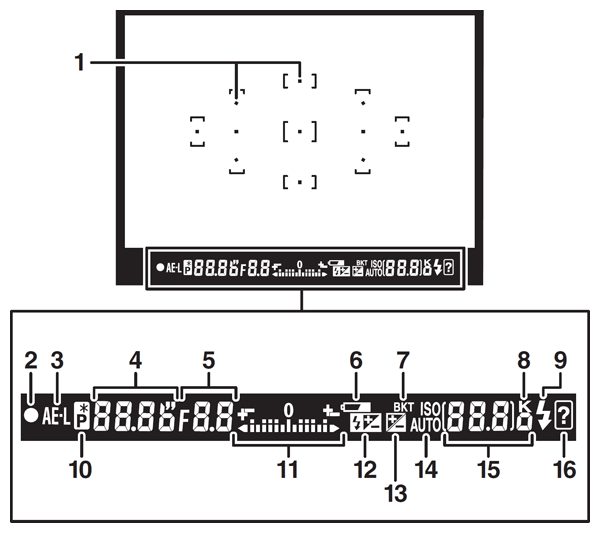
Another handy feature of many recent Nikons, which to be me is a biggie--they allow you to set ISO to display in the viewfinder, even if it doesn't out-of-box. To me this is VERY important, as ISO is an important shooting parameter, almost as important as f-stop, shutter speed, active AF point etc.  For too long, many Nikon models, even fairly advanced ones like the D80, did not show ISO full-time anywhere (viewfinder or control panel), only if you specifically remembered to press the ISO button would you even know what the ISO setting was. (More advanced models like the D200 and D300 did show ISO full-time in the viewfinder.)
The D5100 viewfinder, section (15) is where ISO displays
if the setting is enabled. Image via imaging-resource.com

Thankfully, most recent Nikon models have addressed this, out of box they don't but a custom setting easily allows you to remedy this. The Nikon D90, D5000, D5100 and D7000 among others will, by default, instead always showing the number of images the buffer currently believes it can handle in quick succession, (appearing as something like "r12") but can easily be made to show ISO instead (except during the very brief period the shutter release is "half-pressed," at which time it does show "r12" etc).

To enable this: go to the custom settings, under "shooting, display" and look for "ISO display" and set it to "on." (On my D5100, it's under "d2.") Note: for the D90 and D7000, there is also an "easy ISO" option. What this does, in aperture-priority mode (not sure how it works in other shooting modes), is the front dial changes the f-stop/shutter-speed combination (as before), but the back dial is now a full-time control for ISO without having to press any buttons, just as the front-dial is a full-time control for f-stop. You may like it, or not.

I am not sure what the D3100 or D3200 are capable of, but if you remap the "Fn" button to ISO, the D3000 will display ISO in the viewfinder as you're changing it via the Fn button.

-----------------
1. The Nikon D3000, D3100 and D3200 do not have "green dot" reset feature wired to 2 hard buttons, but have a similar feature within the menus. On the D3000, this feature also resets image-processing parameters-presets, not sure how it works on the other models.

Thursday, May 31, 2012

Make Your Colors "Pop"

Click to enlarge (20120318_134251_nl_b_lr3_epl1)
Olympus E-PL1, 14-42mm II at 22mm,
1/160 second f/5 ISO 200. A "Normal, Large" JPEG.
In recent months-years, it seemed to me that many other photographer's shots seem to have that "spice" to them that mine seemed to lack. A fellow photographer (whom I sold my original Nikon D40 to in 2009, in fact) pointed out the reason--I needed for the colors to "pop."

It's funny--I had expended so much effort trying to make the colors "right" (not a bad thing in & of itself), especially in terms of using the "eye-drop" white balance tool for RAW files, that I had not really thought about the possibilities and, in fact, dismissed the comment initially. After awhile, though, I decided to try it out, and I must say, I really like the results.

The attached photo shows a "before & after" of such a recent shot, my shot Adrian playing putt-putt at Fire Mountain in Tyler near his 3rd birthday last March. The "before" shot is probably more "correct" in terms of its colors, but the after--it really "jumps out at you," yet (to me) does so without seeming artificially "jacked up" or "cartoonish." That is one element to remember in this--you don't want to overdo it and have the shots end up looking totally ridiculous in the process.

In this case, I used a set of Lightroom 3.5 presets that easily do this for you in an instant; however, with this photo, the preset was too strong and "cartoonish," in my opinion.1 The problem: Lightroom 3 doesn't allow you to vary the strength (or "opacity") of a preset action, though--it's all or nothing. The workaround (which I found by a Yahoo! search):

  • I did an "export" of the image with no parameters changed
  • I applied the preset, did another export under a similar (but different) name
  • I opened both files in Photoshop (CS, yes, I'm cheap, ha ha)
  • I navigated to the "window" of the edited version
  • I did "Select...All" then "Copy"
  • I navigated to the "window" of the original, then did "Edit...Paste"
  • The image now looked like the edit, but with the "layers" palette now visible, & with the option to vary the "opacity" (it defaulted to 100%), I simply varied the setting up & down until it looked right
  • I then did "flatten image" under the "layer" menu
     
That's it!

So try it sometime, you may find that giving a little "pop" to the colours in your photographs (but again, don't overdo it and make them appear "cartoonish") can really add some "spice" to your photographs.

(And to my original D40's new owner, thank you for the tip!)

-------------
1The presets were created by a photographer (Oh So Posh) who shoots with a Nikon D700, a camera that typically has very "neutral" colors by default. However, this image was shot with my Olympus E-PL1, which is known to have more "punchy" default parameters by default. This probably explains why it was too strong here--I have noticed that the action's settings are more appropriate as-is when I apply them to the RAW files from my Nikon D5100.

The Value of Props in Photographs

One thing I'm learning myself--the value of "props" in photographs. This photo I took almost 2 years ago illustrates this. (Moreover, the subject, a 7 year old child, actually helped me in that regard--how embarrassing, ha ha.)
Click to enlarge
(20100801_154151_nl_c_lr3_d40)

I am learning this myself--props give some "character" to an otherwise everyday photo. They give it a sense of spice, and in some cases they can even speak about some aspects of the personality of the subject you're shooting. In this case, the subject, our nephew, happens to love watermelons, and we had him on an outing near Tyler Lake State Park and there was a watermelon stand in someone's yard nearby. We stopped by and he and the others really enjoyed it very much.

While doing so, I decided to just take a "casual click" of the event to commemorate it. My nephew saw the watermelons & had the idea himself to pose on them in this way, and "hammed it up" for my Nikon D40 kit. What a brilliant idea--from a 7-year old!

The watermelons in this picture (a) remind us of this adventure (b) stress the awareness of our nephew being a huge fan of watermelons and (c) just plain "spice" up the photograph and make it more interesting.

I would say that a photo does not NEED such a "prop" to make it a good photo, many "plain" photographs without props can still be great photographs. However, photos like this say to me that one would be well served at times to search out props if possible and see, you just never know what they can do to spice up your photographs!

And heck, in this case, it was a 7-year old kid (our nephew) who helped me be aware of this.